Hygienic or aseptic valves? Why understanding the difference matters in food & beverage processing
6 Min Read
Share
The food and beverage industry relies on two main approaches to contamination control: hygienic processing and aseptic processing. Both are designed to protect product safety, quality and shelf life, but they achieve this through different levels of control. These different approaches also determine the type of process equipment required, including whether hygienic or aseptic valves are appropriate for the application.
Understanding the difference between these two processes is essential when designing, operating or upgrading a food and beverage production system. The required approach depends on factors such as the product, its sensitivity to contamination, the desired shelf-life, cleaning and sterilisation requirements, and the conditions under which it will be processed and packaged. These requirements directly influence the type of valve that should be specified, as hygienic and aseptic valves are designed to provide different levels of contamination control.
In the food and beverage industry, product safety, consistency, and shelf life all depend on effective contamination control. Whether producing milk, beer, wine, or soft drinks, manufacturers must ensure their processes prevent contamination at every stage.
Valve design plays a critical role in maintaining the highest standards in food safety and quality. As the UK & Ireland’s only Authorised Channel Partner for Pentair Südmo Spares and Components, a global leader in hygienic processing solutions, we have extensive experience in specifying valve technology that protects product quality, ensures compliance, and supports reliable production.
This guide explains the key differences between hygienic and aseptic processing and the factors that should be considered when selecting a hygienic or aseptic valve for a food or beverage application.
Hygienic and aseptic processing in Food & Beverage
Before we dive into hygienic and aseptic valves, we need to understand the difference between hygienic and aseptic processing, as this directly influences the type of valves required.
Hygienic processing
Hygienic processing focuses on keeping systems clean and reducing contamination through effective cleaning regimes and well-designed hygienic valves.
While hygienic systems are highly controlled, the objective is to maintain a clean, sanitary process rather than to maintain complete sterility throughout production. This approach is widely used across brewing, distilling, general dairy processing, and carbonated beverage production.
Aseptic processing
Aseptic processing takes this a step further by aiming to maintain commercial sterility and prevent microbial contamination and recontamination during production. It requires sterilisation of product-contact surfaces and carefully controlled process conditions to maintain a sterile boundary throughout the relevant stages of production.
This is achieved through processes such as Sterilise-In-Place (SIP), appropriate sterile barriers and hermetically sealed components, together with tightly controlled operating conditions. Aseptic systems are essential for products such as UHT milk, long-life beverages, and sensitive liquid foods where control of microbial contamination is particularly critical.
The key distinction is the level of contamination control required. Hygienic processing is designed to provide effective cleaning, sanitation and contamination control, while aseptic processing is designed to maintain sterility and prevent recontamination during production. This distinction is important because a valve that is suitable for a hygienic process is not automatically suitable for an aseptic one.
What makes hygienic and aseptic valves unique?
Hygienic and aseptic valves are unique because they are engineered not just to control flow, but to minimise contamination risks through their design and to support effective cleaning and, where required, sterilisation.
They typically feature:
Smooth, crevice-free internal surfaces
Carefully selected materials — typically high-grade stainless steel with defined surface finishes to resist corrosion and minimise areas where contamination can accumulate
Fully drainable bodies to prevent product residue from accumulating
Internal pathways that allow cleaning fluids and, where applicable, sterilising media to reach product-contact areas
Seals and materials selected to withstand repeated CIP and, where required, SIP cycles
What is CIP and SIP?
Clean-in-Place (CIP) and Sterilise-in-Place (SIP) are important process technologies used to maintain hygienic and aseptic systems without requiring equipment to be dismantled. Valves form a critical part of these systems and must be designed to allow effective cleaning and, where required, sterilisation of product-contact areas.
Valves are often potentially high-risk points for contamination within a process system. If poorly specified, they can allow product to become trapped and create opportunities for cross-contamination and stagnation. It is therefore crucial that valves are designed to withstand the relevant CIP and, for aseptic applications, SIP processes.
CIP (Clean-in-Place) is used across most food processing systems to remove residues and maintain hygiene. It is a fundamental requirement for many hygienic food processing applications. A CIP cycle typically uses water, acids, and caustics to flush away physical dirt, product residues, and chemical soils from surfaces.
SIP (Sterilisation-in-Place) is used in aseptic systems to achieve and maintain the required level of sterility. It commonly uses high-temperature steam (typically 121°C or higher) to kill microorganisms and spores, meaning aseptic valves must be designed to withstand repeated SIP cycles while maintaining seal integrity and process performance.
Watch the video below demonstrating both CIP and SIP cleaning processes.
What types of valves are used in hygienic and aseptic processes?
Both hygienic and aseptic valves play a crucial role in preventing contamination within food processing systems. The technology involved can vary depending on the process requirements.
Not every hygienic valve is suitable for aseptic service. Valve selection depends on factors including the required level of hygiene, cleaning and sterilisation regime, product characteristics, pressure and temperature, and whether different media need to be separated.
We supply a range of hygienic valves through our manufacturing partners Pentair Südmo and Flowserve including single seat valves, double seat valves, hygienic butterfly valves and Worcester FoodSafe three-piece ball valves.
Single seat valves
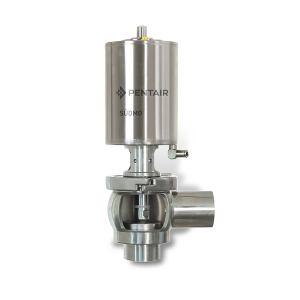
Single seat valves use a simple lift-seat design where a plug seals against a single seat – ideal for straightforward shut-off applications and applications where reliable cleanability and hygienic design are required.
Double seat valves
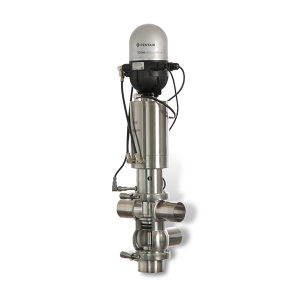
Double seat valves (often called mix-proof valves) take this further by incorporating two independent seals with a leakage chamber between them. This design allows two different media to flow through the valve simultaneously while keeping the product streams separated. The space between the two seals provides a controlled leakage chamber so that, in the event of a seal failure, the two media do not immediately mix. This makes double seat or mix-proof valves particularly useful where product and cleaning media need to be separated, or where production and cleaning operations need to take place simultaneously.
Hygienic butterfly valves
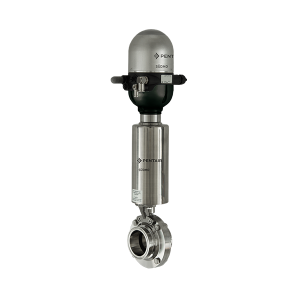
Hygienic butterfly valves offer a compact and cost-effective solution, using a rotating disc to control flow. They are widely used in hygienic applications because of their relatively simple construction, ease of operation and cleanability. However, their suitability for aseptic applications depends on the specific valve design and process requirements.
Food safe ball valves
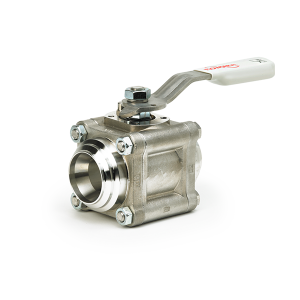
Food Safe ball valves reduce the risk of contamination and product build-up through suitable materials and hygienic design. They use a smooth, non-porous internal construction that minimises areas where food particles, bacteria or contaminants can collect, while food-grade materials are selected to prevent the valve from affecting the product passing through it. They can provide a practical solution for food and beverage applications where hygienic materials, construction and reliable shut-off are required.
Applications across food & beverage industries
Dairy
Dairy processing requires effective CIP because milk residues can support microbial growth. Hygienic valves are used around heat exchangers, separators and storage tanks to provide cleanability, drainability and minimal product hold-up. However, UHT and extended shelf-life products require aseptic systems that maintain sterile conditions and prevent recontamination. In these applications, valves may need steam barriers, SIP capability and reliable separation between product and cleaning media.
Brewing
Breweries use hygienic valves throughout wort transfer, fermentation and conditioning, where sugars, yeast and proteins can cause fouling. Butterfly and seat valves are commonly selected for their cleanability and reliability during frequent CIP cycles. During fermentation, even minor contamination from wild yeast or bacteria can significantly alter flavour profiles and spoil entire batches. As a result, valve integrity, seal performance, and elimination of dead legs (areas where product or cleaning fluids can stagnate) are critical considerations. In modern breweries, automated valve manifolds and mix-proof valves are increasingly used to enable simultaneous cleaning and production, improving efficiency without compromising hygiene.
Distilling
Although distillation involves high temperatures that inherently reduce microbial risk, hygienic design remains essential to ensure product purity and consistency. Residues from mash, fermentation by-products, and previous batches can impact flavour if not effectively removed. CIP systems are therefore widely used, particularly in larger or continuous distillation setups.
Valves in distilleries must withstand both aggressive cleaning regimes and exposure to alcohol vapours and liquids. Material compatibility and seal selection are key factors, as is the ability to fully drain systems to prevent carryover between batches. In premium spirits production, where subtle flavour differences are critical, even minor contamination or residue can have a noticeable impact, making valve specification an important part of process control.
Wineries
Wine production presents a unique challenge, requiring a balance between hygiene control and preservation of desired microbial activity. While certain fermentation processes rely on naturally occurring yeasts, unwanted spoilage organisms must be carefully controlled through effective cleaning and system design.
Hygienic valves are used throughout processes such as juice transfer, fermentation, clarification, and bottling. Smooth internal surfaces and gentle product handling are particularly important to avoid damaging delicate flavours and aromas. CIP is widely used, but often with carefully selected cleaning agents and parameters to suit the specific requirements of wine production.
Valve selection in wineries must also consider flexibility, as processes can vary significantly between batches, grape varieties, and production methods. Reliable sealing and cleanability ensure that each batch maintains its intended character without cross-contamination.
Carbonated drinks & soft drinks
The production of carbonated and soft drinks requires high levels of hygiene to ensure product stability, taste consistency, and shelf life. Syrups, flavourings, and sugars can create sticky residues that are prone to microbial growth if not properly cleaned, making effective CIP essential across mixing, carbonation, and filling stages.
In high-speed production environments, valves must perform reliably under constant operation while maintaining hygienic integrity. Mix-proof valves are often used to allow simultaneous product flow and cleaning, maximising uptime and efficiency.
For extended shelf-life products, aseptic filling systems are increasingly used to eliminate the need for preservatives. In these applications, valves must support SIP processes and maintain sterile conditions right up to the point of packaging. This places significant demands on valve design, including resistance to thermal cycling, secure sealing under pressure, and the ability to prevent any ingress of contaminants.
Choosing the right valve for your process
The choice between a hygienic and aseptic valve should always be based on the requirements of the specific process rather than simply the product being manufactured.
Key considerations include:
The level of contamination control required
Whether the process requires CIP alone or both CIP and SIP
Product characteristics and sensitivity
Operating temperature and pressure
Required drainability and cleanability
The need to separate different media
Seal and material compatibility
Whether production and cleaning need to occur simultaneously
Understanding these requirements at the specification stage can help reduce contamination risks, protect product quality and avoid selecting a valve that is unsuitable for the demands of the process.
Whether you are processing dairy, beer, wine, beverages or other high-purity products, selecting the right valve technology is essential to maintaining reliable and hygienic process performance. Pentair Südmo is globally recognised for precision-engineered valve solutions designed specifically for hygienic and aseptic applications in the food and beverage industry. Explore the Pentair Südmo range here.
These valves are engineered to support CIP and SIP processes, minimise contamination risks, withstand thermal and chemical stress, and reduce maintenance and downtime.
Why choose Valve & Process Solutions?
Valve & Process Solutions is the UK & Ireland’s only Authorised Channel Partner for Pentair Südmo Spares and Components, offering not just products but complete technical support. We work closely with customers to specify the correct valves for their application, configure systems for optimal performance, and ensure compliance with industry standards. Whether upgrading an existing plant or designing a new process line, our expertise ensures you get the right solution first time.
The right valve starts with the right specification
Whether your application requires hygienic or aseptic valve technology, selecting the right solution starts with understanding the process requirements. The right specification can help protect product integrity, maintain hygienic standards and ensure reliable performance throughout the process. With the right valve technology specified from the outset, you can select a solution that meets the demands of your application and supports efficient, dependable operation. Our team can help you assess your requirements and identify the most appropriate valve solution for your process.




 10 Min Read
 5 Min Read
 5 Min Read


